From solutions to responses
In the here and the now, we’re embedded within intergenerational timelines that constrict, empower and shape us. In this space between the past and the future, we can practice ‘mind-fulness’, ‘heart-fulness’ and ‘care-fulness’. We can pause, we can shuffle, we can wriggle, re-orient and side-step. There are many movements, many ways to be and many things to do in the here and the now.
Often, we find pain and suffering in the here and now. It likely goes without saying, that we are living in times and places wrought with historical and current harms. In my day to day work in communities in colonial Australia, I’m finding ways to be with and respond to harm that I hope will contribute to kinder, more compassionate futures, some of which I likely won’t live to see.
As part of that work, I’ve been paying attention to and co-cultivating forms of pause and response that try to respect the minutia of our interior lives, the macro of our external world and the places between.
I am finding that together we can respond to harm, to suffering, to grief, to loss, to shock and terror in ways that deepen and expand our human capacities. I am witnessing how capacities we germinate and strengthen in private therapy spaces can go on to move us and our complex systems in influential ways.
We don’t often know exactly how the quality, texture, tone, shape or timing of our pause and response will ripple into the future (or past), but we know that it will. We know that our children are inheriting our responses, whatever they might be. We know that we ourselves have inherited so many painful and sometimes, unintended consequences of responses made in the past (from those we do and don’t know ).
Image: Mati-Mango
Medicines
Many responses emerging from ‘discoveries’, ‘developments’, ‘solutions’ and ‘progress’ are especially pernicious and continuing to sweep us into painful survival strategies and side-effects. It’s hard to choose an example from so many, but for now, let’s just use the example of our amazing medications. Medications have saved my life on occasion, and yet, medications are also in many ways accommodating us to systemic suffering, rather than transforming it. They can provide some relief and stabilization, they can numb us to the broader sources of the very distress they are treating and they can bind us to the status-quo.
I’m thinking in particular of medications that children with neurocomplex¹ minds are often prescribed. Prescriptions are made to radically alter the developing neurobiology of our little ones to make their behaviours more tolerable for them and others in the environments they inhabit. Yet, very little prescription and breadcrumb resourcing are made available for the contexts these children occupy.
An entrenched obsession with childrens ‘self-regulation’ accompanies limited curiosity about the what is happening in their complex lives that is generating dysregulation. Teachers are left to attend to cohorts of children who carry unspoken, yet acted out, needs and experiences into classrooms. Our bodies are buckling as our medical systems attempt to plug a sinking colonial ship with chemical coping strategies. For all the incredible research on the way our neurobiology, attachment strategies and minds are shaped by relationships of all kinds, we are yet to grow wide-spread learning environments that meaningfully integrate this knowledge.
What kind of pause and response do we need to cultivate together to grapple with this?
There is so much yet to learn together, practice, reflect on and amend in our pauses and responses as we live in the contexts we find ourselves in. For example, in my work with children, I’m learning about how much pausing to attend to sensorial care can matter and make a difference.
Adaptions to noise, lighting, movement possibilities and the opportunity to be embedded within environments where multi-species accompaniment is possible (this week the crickets were a special invitation to pause) can provide deep relief for young ones. Opportunities to orient to a safe enough, resource rich and relational environment can transform the regulation or dysregulation a child experiences.
I imagine that this kind of pause not only matters in the moment, but may also matter to the future as these young ones find their own spaces to engage in a reciprocity of response for the environments which have nurtured them, down the track.

Image: Pat Whelan
Metacrisis / Polycrisis
Across so many domains, we are living with patterns of problem to solution to more problems to more solutions to an unlimited set of compounding and intersecting problems. The meta-crisis² is one term for this experience we are living through. The polycrisis is another. If we really face these crises, we see that there is no answer at the back of the text book or ‘evidence-based’ modality that can deal with the complexity of the situation we are each and collectively within. Perhaps, in facing this, you may wish to pause and consider how you might now respond. Perhaps, you may wish to develop ways to pause and respond differently or similarly to what you’ve explored in the past.
Let’s practice by pausing the problem-solution-problem making machine for a moment.
Let’s ask instead:
What makes it possible to pause?
What do you notice in your experience when you have a felt-sense of pause?
What sensations arise when you pause?
How does the pace of your pauses and responses impact the care of individuals, families, communities and more-than-human kin?
What are your response-abilities?
How do you response-ably care for and tend to the harms you have inherited and sustained?
Which aspect of your abilities to respond might need compassionate attention and further learning?
What (perhaps slow and tiny) responses might you make towards increased abilities to act with and embody care and compassion?
What pauses and responses are within your reach?

Image: Nedelcu Catalin
The Heart Field
There are many times where it may feel that a pause is not possible. Yet, a continuous flow of pause and response within reach is your beating heart. Regardless of your time or place, if you are a human reading this, your embodied heart is reverberating within you and reaching outwards from you.
The HeartMath Institute illuminates the invisible magnetic field that radiates from each of our hearts (see image below).
This field of energy can be profoundly impacted by harm, as well as grown and mended with skillful care.
Your heart is in flows of pause and response that influences the humans, animals and other life forms around you. I mean this in both a literal and metaphorical sense.
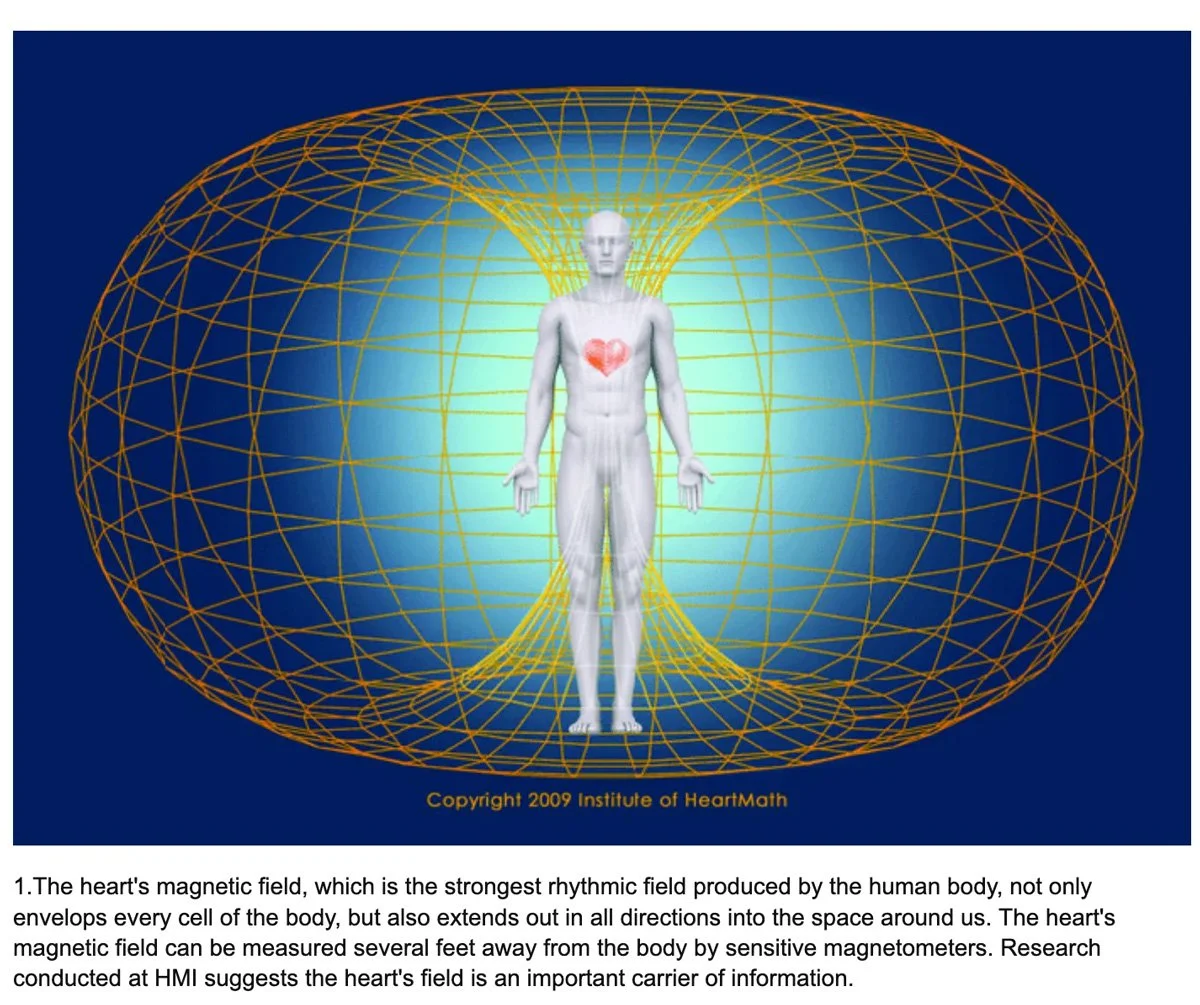
Image: McCraty, Rollin. (2016). Science of the Heart, Volume 2 Exploring the Role of the Heart in Human Performance An Overview of Research Conducted by the HeartMath Institute. 10.13140/RG.2.1.3873.5128.
There is much we can do to practice caring with heartfelt pauses and responses.
Should you wish to care for the heart/s that surround (and is within) you, perhaps you could consider:
What kind of care-ful pause and response might you offer your heart in the here and the now?
Can you pay attention to the pace, rhythm, pulse, and space in your heart?
Can you imagine that your heart has an intelligence to offer you?
What does your heart contribute to your body and life?
How does this shape your patterns of response to people, places and purpose?
Your heart may yet be somewhat of a mystery to you. There may be parts of your heart you had to turn away from.
Perhaps your heart beats erratically and you don’t quite trust it’s wisdom.
Yet, your heart is capable of survival under extraordinary pressures and pain.
Your heart is pausing and responding again and again and again.
Broken, weary, ecstatic, beating – we can tend heart-felt presence and join a rhythm of collective coherence, of pause and response, for a kinder future together.

NOTES
Donna Harawayis credited with coining the term "response-ability"
Aline LaPierre explores and teaches the interconnectedness of the body’s multiple systems, challenging the traditional hierarchy of brain superiority to the body
Rebecca Solnit suggests that the “positive consequences of our acts are not always immediately seen, directly knowable, or even measurable, and that pessimism and despair rest on an unwarranted confidence about what is going to happen next” in Hope in the Dark: Untold Histories, Wild Possibilities
READING LIST
Haraway, Donna J. Staying with the Trouble: Making Kin in the Chthulucene. Durham: Duke University Press, 2016.
LaPierre, Aline. NeuroAffective Touch: Healing the Relational Matrix. Berkeley, CA: North Atlantic Books, forthcoming.
Solnit, Rebecca. Hope in the Dark: Untold Histories, Wild Possibilities. 3rd ed. Chicago: Haymarket Books, 2016.
I want to acknowledge that my writing about transgenerational harm, care, and our relationships to place and more-than-human kin has been shaped by my settler ancestral lineage within Indigenous land.
I recognise that Indigenous peoples have maintained sophisticated understandings of healing and relational care across generations for tens of thousands of years. I acknowledge Indigenous knowledge-wisdom systems predate Western frameworks and are ongoing.
References
“Neurocomplexity” is a term coined by Lindsey Mackereth which serves as a way to expand our understanding of neurodivergence and its many layers
The Civilisation Research Institute describes the metacrisis in this way: “Critically, metacrisis points to a deeper pattern that connects all risks and crises into a single coherent field: an ecosystem of crisis dynamics, with its own emergent properties. It points too towards the human experience, to the complexity and increasing confusion at the heart of how we all perceive, understand and operate across the field of converging risks. The metacrisis is a higher-order whole, with unique dynamics and unforeseen consequences. The metacrisis is both seen and unseen, taking place above and below the surface of what is visible and obvious”