
I’m in a rush.
I can feel it sweeping through, between, under and around me.
I can feel it collecting me and all that I can gather and scatter in a precious moment I fear might be my last. There seems to be no immediate threat, yet the rush whirs in my ears and under my skin.
It reminds me of the feeling when your flight is preparing for takeoff and you know you’re moving with force. Yet, you can’t really perceive just how much power you’re being lifted with.
It’s loud and it’s compelling. It has to be. You’re going somewhere and the rush is sending you there.
What do we do when we want to slow down, observe more and react less?
When we don’t want to meet crisis with crisis?
What do we do when the vortex of culture, history, metabolism, autonomic nervous systems and family have other ideas?
When the rush is bubbling in ways we can barely sense, let alone control?
Telling the rush to take it easy is like asking a wave to delay.
I suggest we pay attention to the rush and get to know it.
Let’s create a time and place where it can be welcome, where it can move and swing.
There is no point trying to trap it, deny it, stop it or shame it. The rush has brought us here and we still have places to go.
Let’s ask the rush to help us understand its quickening, its power, its refusal to be quiet and calm.
Let’s press our ear up close and listen to the echo it’s singing us into.
Listening to the Rush
of ancestral undercurrents
Often, when people arrive to meet with me in my therapy practice, they are also in a rush. I’m sure you know something of this feeling, given we have all inherited late-stage neo-liberal capitalism, inter-generational wars, colonialism, dislocations, global ecological devastation and widening inequalities.
Once these issues arrive in individual bodies to therapy, they have other names like, ‘dysregulation’, ‘anxiety’, ‘borderline personality disorder’ and ‘trauma’. Collectively and individually we are urgently attempting to understand, address and transform the states of suffering we find ourselves in. Yet, so many of us have such little knowledge of how our suffering has been and is generated. When we have a poverty in our understanding of the context of suffering, we have a poverty of response. We have autocrats, trillionaires, monocropping and fracking.
This got me thinking that it might be worth spending some time paying attention to the ways in which the intimate disturbances we sense and grapple with in our cells, in ourselves, are entwined within deeper timelines and relationships. I’m offering a reflective inquiry on this theme here by considering the way my ancestral root systems create a sense of underlying rush that ripples through my daily life and ways I’m finding to respond.

Woman with basket | Shetland Islands
Basket Making
As I research my lineages, I find myself weeping over pictures of ‘kishie’ baskets traditionally woven in the Shetland Islands. I look at pictures of this type of basket behind museum glass, carried by women, carried by Shetland Ponies and in various stages of development and use. I search for people from whom I might learn from in my local community to begin to make a basket like this.
I’ve recently received a set of hand woven baskets and the gift touched me. Something about receiving this offering has made grieving and connecting with the loss of my own ancestral cultural practices more possible. Sometimes, you don’t know you’ve lost or never known something until you’re holding it in your hands.
My weeping comes to an edge when I begin to witness photos of family groups and kin in the Shetland Islands who are weaving baskets together. The edge is a rush of panic. I avert my eyes.
Noticing that I turn myself away from witnessing this aspect of my ancestral histories, I get curious about my grief, my fears and my avoidance.
Why when I look at an individual basket do I experience grief, but when I look at the basket makers, I start to experience panic?
How and why did I learn that I use avoidance to meet panic?
What is ‘avoid’?
Emptiness, absence, void.
Unnamed, Denied and Disowned Fears
Basket making might seem a strange thing to notice grief and fear around, but perhaps you have your own experiences where your feelings didn’t seem to match the events.
Listening to what is happening under the surface of things is one way I know to deepen my understanding of a mystery like this. I find a way to feel into the undercurrents by paying attention to cultural and collective patterns. If I look for others I can see are experiencing strange responses to seemingly mundane things, I begin to notice I am not alone in experiencing fear and using survival instincts and strategies when confronted with historical realities.
For example, Australian politician Bob Katter recently made a threat of violence to a reporter when he was asked about his ancestral lineages. In claiming a sense of belonging of Australia, Bob appears to deny his ancestors with veracity. Strange? In many ways, yes.
When some of us are afraid, we instinctually fight, some of us run and/or we hide-dissociate. Often, we create a habitual groove with a autonomic nervous system pattern that served us best in our families of origin and childhoods. Sometimes these patterns and strategies help us survive and sometimes they jeopardise ours and others survival.
Bob’s aggressive response to a question about his ancestral heritage made me curious about what he fears. It also made me worried that when we don’t face those fears with maturity, we can replicate and repeat the harms our fears arose from.
I think it’s critical to our current individual and collective experience that we work to find ways we can turn towards our fears, meet them, respond to them and transmute them.
I can’t offer an answer for Bob Katter’s fears and responses, but I could ask myself what I’m afraid of and how I might respond to the confronting ancestral stories that are rippling through me.
Acknowledging and Naming the Fears
“The heart that breaks open can contain the whole universe” Joanna Macy
Fears of feelings of grief & loss
There is an enormous space between my ancestral waters of the North Sea and my homeland waters of the Brisbane River and Pacific Ocean. Perhaps I am afraid of the overwhelming truth of what and how much has been lost between these seas. The way aunties, cousins, wind, seals, stone, peat, straw, boats and ponies are connected in ways I will never know. The loss of of living and relating within ancestral land, language, crafts, culture and kinship groups.
Perhaps I fear that seeing my separation by sea will confront me with the nature of my split-off self in a clearer and wider way. Perhaps I am afraid of the grief that arises on admitting to such indelible loss, afraid of my inabilities and failures to close the gap between the seas and meaningfully re-connect.
Perhaps I am afraid of the deep grief within and between me and my ancestors that accompanies this separation.
Fears of feelings of horror, terror & shame
Perhaps I am afraid of what might happen if I did cross the void. Afraid of being overwhelmed by the knowledge of the horrors my ancestors experienced and perpetrated.
I think of the way men, women and children were sent into mine shafts to dig, extract and die. The way ‘progress’ swapped women and children for Shetland Ponies who were then objectified, exported and enslaved in mine shafts across Britain for over 150 years.
I think of the way colonisers objectified, exported and extracted people from their Isles to enslave, objectify and extract from Indigenous peoples and their country that I now live within.
I think of how objectification, extraction, and exportation are still happening, here and now. I’m weeping again.
Perhaps I am afraid of these deep horrors, terrors and shame within and between me and my ancestors that accompany these abuses.
Fearful Dilemma’s
Perhaps I am panicked by the dilemma that arises in longing to connect with my ancestral ways and kin and my knowledge of the horrifying histories that inevitably come with this.
Individual & Collective Dissociation
There is concept that permeates across the fields of developmental neuroscience, attachment research, interpersonal neurobiology and trauma studies that claims children have a core need to establish relational connection with primary care-givers for their survival.
We are born with compelling neurobiological functions to obtain connection that are expressed through attachment seeking behaviours. For example, we reach for, grasp and pull towards us hoped for nourishment from those older and wiser. We seek shelter, protection and guidance from those stronger and kind. In a world where cycles of ease, challenge and threat unfold, we need each other.
But when care-givers and kin become a primary threat, children experience a survival dilemma. There is an intense, internal, rushing force towards care-givers for safety and an intense, internal, rushing force away from them for safety. In this context of opposing internal forces and survival dilemmas, dissociation can come to the rescue.
The concept and experience of dissociation involves changes in brain connectivity, particularly between areas responsible for memory, emotion and self-awareness. Memory gaps, contradictory behaviors, internal conflicts, and difficulty maintaining consistent relationships or function are some traits associated with the phenomena.
What if a fearful dilemma was happening to us on a collective level? Is the desire of longing to connect to long-lost culture and kinship competes with the desire to disconnect from our painful pasts? Is this contributing to a kind of cultural amnesia?
How is intergenerational, historical and cultural amnesia contributing to suffering?
What do we continue to lose and harm if we remain in states of cultural amnesia?
Is collective and individual dissociation preventing us from sensing we need to develop skills to do the urgent work to stop abuses some of our ancestors started and re-weave compassionate, respectful and regenerative cultures?
What would thinking about our individual and collective experiences like this offer in terms of creative and embodied responses?
Dissociation, fear, instinctual responses, complex inter-generational migrations, sufferings and grief aren’t something to ‘fix’. But they are something we could listen, tend to and learn from.
Humans have never been alone as we experience life and perhaps we could be curious about what we could learn from other species who have have accompanied us over waters, through wars, famines and fire.
Steadying ourselves amidst the Fears - Horse Stories
Amongst my own rush, fears, dissociation and grief I have known a powerfully steadying force in my life. Horses have been companions to me since my earliest days and aptly, my name means ‘friend/lover of horses’. I’ve always been cared for by creatures who don’t have human bodies and I’m in a deep, grateful debt to them.
Horses provided me with a sense of relational safety, connection and guidance during some of the most challenging seasons of my life and I believe there is a lot we can all learn from horse wisdom. Finding compassionate and courageous companions to journey with our ancestral inheritances seems vital to me. Perhaps you have your own animal kin who provide comfort and a steadying presence in your life.
My orientation towards learning from our multi-species kin, led me to read some stories about ancestral flows of horses across the globe. It seems that horse evolution is one of the most complete fossil records we have, spanning approximately 56 million years. Apparently, horses first emerged in North America with Eohippus, a fox-sized, multi-toed forest animal that lived during the Eocene epoch. Over millions of years, horses underwent extensive changes including growing larger, developing longer legs for running and moving to single hoofs. Approximately 4 million years ago, Equus emerged.
In comparison, humans are a more recent life experiment. While our lineage splits from other apes around 7 million years ago, modern Homo sapiens has only existed for about 300,000 years. In other words, we’re the new kids.
Horses know what it’s like to experience challenging historical events. One event that threatened their continuity occurred in North America around 10,000-12,000 years ago, when, alongside massive extinctions including mammoths, giant ground sloths, sabre-toothed cats, and many other megafauna, horse numbers were decimated.
However, millions of years earlier, horses had spread to other continents via land bridges and populations in Asia and Europe survived. These populations were then later domesticated by humans around 3500-4000 BCE in the Eurasian steppes. Some horses also survived in North America and developed sophisticated kinship relationships with Indigenous peoples there.
The descendants of horses that spread across the globe, eventually returned to North America when Spanish colonists brought them back across the seas in the early 1500s. Some of these horses escaped or were traded to Indigenous peoples in the Americas, enabling the descendants of the original horses to re-establish themselves across the Great Plains and western regions.
These sea-faring horses returned to the environment their ancestors had emerged from (and experienced near extinction in), coming to re-occupy an original ecological niche as well as re-join their ancestral herds.
Sensing & Responding to the Flow of Life Force
These stories are not just interesting historical anecdotes. They are stories that help me be with the rush in a different way. In stretching my view of what has happened over deep-time, is happening now and might yet happen, the fears I named earlier find a place in a greater story.
Considering time in this way allows me to sense the ocean, and tides, not just the rushing wave at times I find myself within.
Moving beyond dissociative states will require us to sense more than just the rush. It will need us to sense the ways we and other species have and continue to flow with life’s unfolding ways. To re-member ourselves amongst our more-than-human kin. To attune to our survival responses alongside our capacities to give and receive care, connect, find belonging, healing and for adaptation. We will need to understand not only what generates suffering but what nurtures love, compassion and aliveness.
Attuning to synchronicities
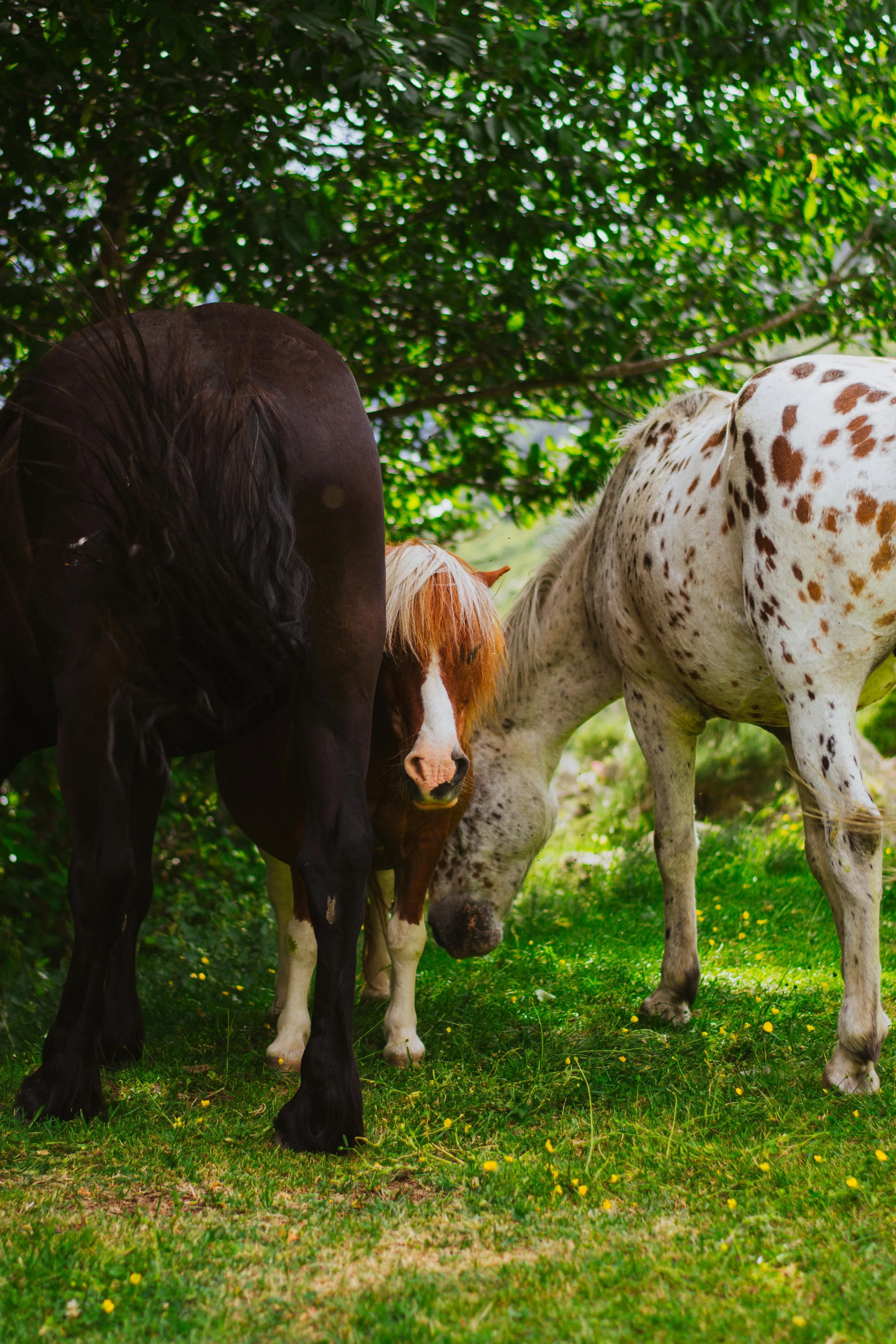
Strangely, on the day I was writing this, I encountered Shetland ponies. These small equine beings are renowned for their strength and resilience alongside their small stature. Archaeological evidence indicates their presence in the Shetland Islands dating to the Bronze Age.
Knowing about my kindred connection with these little survivalists, my partner sent me a picture of some he came across.
I have the sense that my animal kin might have been letting me know they were listening in to these stories about dislocations, multi-faceted histories and all has not been lost. We are still alive, despite continental changes and against the odds.
Their presence makes me hope that perhaps together with our multi-species ancestors and kin we can find ways to return to a more grounded and respectful ecological niche.
Attuning to to these kinds of synchronicities and resonances might be a kind of practice available to us, as we learn to acknowledge the rush, steady ourselves, face and metabolise our fears and allow life’s flow to move us into whatever is to come.
Echos
While this reflection is just a fragment of experience, I’m hoping it might offer you something in your own ancestral explorations.
There is so much more complexity to grapple with than I’ve detailed here at this time and mine is only one perspective. I hope you will explore many others.
I’m finishing with the sense that we can sense the echos our ancestors have sent with us into the present and how we reverberate in our life-times might just tend the rush, the griefs, the responsibilities and the ruptures they couldn’t in theirs.
Let’s name, face and metabolise the fears, griefs and rush of our personal and collective pasts so we can sing a new echo to and through our future kin.
Let’s let the rush take us there.

A herd of horses/ponies